Often, yes. Are your workflows feeling complex, fragile, or even unmanageable? They might be, especially if you’re relying solely on the n8n HTTP Request node. This is often the case when you’re tackling advanced authentication, proprietary APIs, or intricate data transformations. So, what exactly *is* a custom n8n node? Think of it as a tailored code module, usually written in TypeScript. It’s designed to put specific logic, authentication patterns, or integration points into one neat package – things standard nodes just *can’t* handle efficiently. Building these nodes gives *you* granular control. It transforms your chaotic workflows into robust, reusable components. If your business needs precision in its automation, understanding when to move beyond generic solutions is critical. It’s much like how specialized AI automation solutions from Goodish Agency provide targeted efficiencies far beyond off-the-shelf tools. Explore comprehensive strategies for advanced automation by consulting the detailed guide to AI automation.
⚡ Key Takeaways
- Generic HTTP Request nodes create complexity for advanced authentication (like OAuth2) and proprietary APIs.
- Custom n8n nodes offer precise control, reusability, and simplified maintenance for complex integrations.
- Developing private, custom nodes in TypeScript with proper deployment (e.g., via Docker) streamlines operations.
The Hidden Costs of Generic HTTP Requests: Why Your n8n Workflows Get Messy
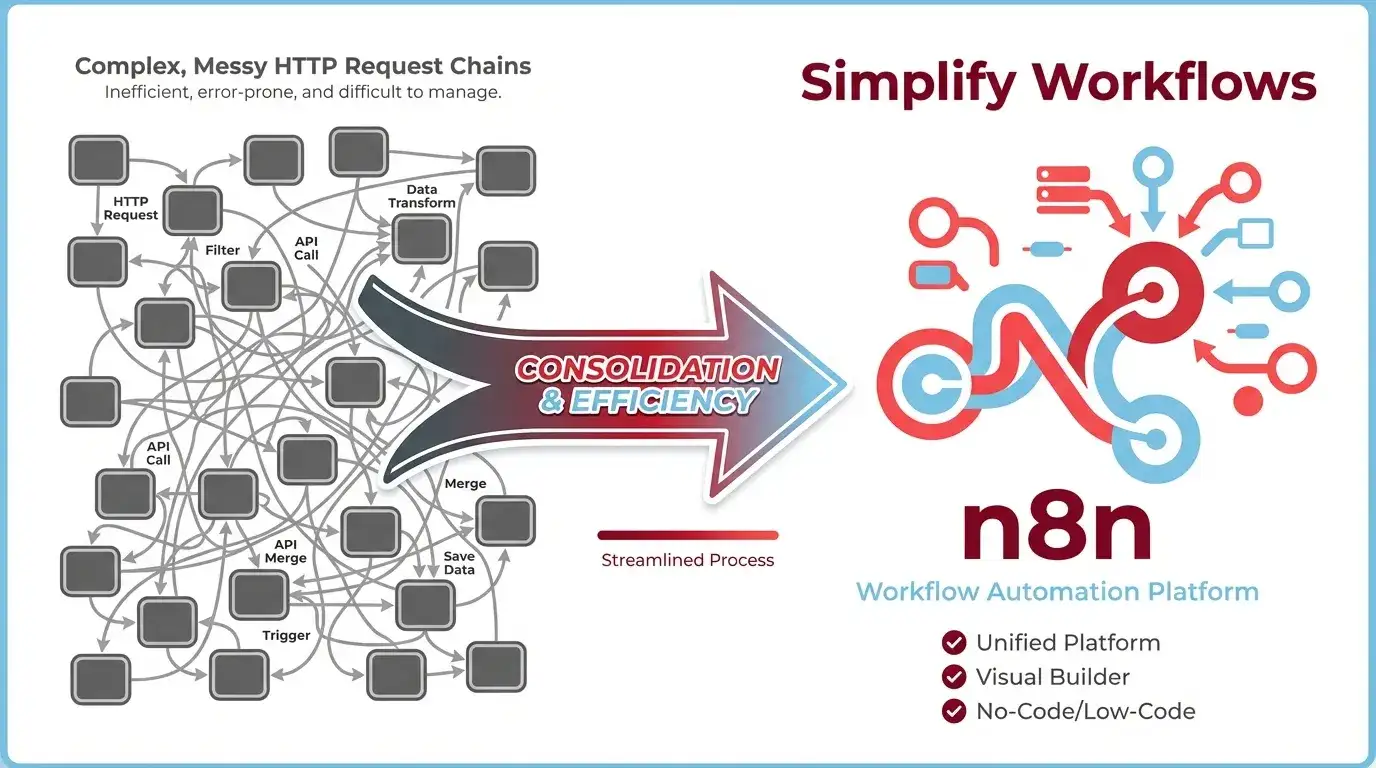
You know the n8n HTTP Request node is powerful for simple API interactions, right? But *its* versatility often becomes a real liability when *your* scenarios get complex. Picture this: multiple nodes all trying to handle token refresh for an OAuth2 API, repeated across several of your workflows. Or maybe you’re stuck parsing a legacy ERP system’s XML output with a bunch of “Set” nodes. Each of these scenarios creates that infamous ‘workflow spaghetti,’ doesn’t it? It makes debugging a nightmare and turns updates into a high-risk operation. Sound familiar? Complex authentication flows – like managing refresh tokens or generating specific headers – just demand custom logic. This clutters up your visual workflows and seriously increases your error potential.
1. Identify Gap
Generic node fails specific need→
2. Design Node
Define inputs, outputs, logic→
3. Code TypeScript
Implement INodeType interface→
4. Test & Debug
Validate functionality→
5. Deploy & Maintain
Integrate into n8n instance
Blueprint for a Custom Node: From Concept to Code
Ready to build a custom n8n node? You’ll start with the `n8n-nodes-starter` repository. Just clone it! This provides you with a structured TypeScript project. Your core task? Implementing the `INodeType` interface. This defines exactly how your node appears in n8n, what its parameters are, and how its execution logic works. Inputs and outputs are managed through the `execute` method. It maps incoming data to your custom logic and structures the results for downstream nodes. You’ll want to bake in robust error handling and data validation right into the node’s code. This prevents workflow failures and ensures solid data integrity. Ultimately, this transforms complex, multi-step operations into a single, clean node *you* can rely on.
Scale Your Business, Not Your Headcount
The secret to 10x growth isn’t working harder; it’s smarter systems. From CRM syncs to autonomous AI agents, we build the infrastructure that runs your business on autopilot.
Custom Node vs. HTTP Request Node: Feature Comparison & Decision Matrix
| Feature / Scenario | n8n HTTP Request Node | Custom n8n Node | Decision Guide |
|---|---|---|---|
| Simplicity (Basic API) | Excellent for GET/POST with simple auth (API Key) | Overkill for simple tasks; higher initial complexity | Use HTTP Request for basic, stateless interactions. |
| Complex Authentication (OAuth2, Sessions) | Requires multiple nodes, manual token management, error-prone | Encapsulates full authentication flow (refresh, storage, retry) | Custom node essential for robust, maintainable complex auth. |
| Proprietary / Legacy APIs | Difficult; manual parsing via “Set” nodes, limited binary support | Directly integrate custom SDKs, parse non-standard formats (XML, binary) | Custom node for non-standard APIs or specific client SDKs. |
| Reusability & Maintainability | Logic repeated across workflows; difficult to update | Single, reusable component; central logic updates impact all workflows | Custom node dramatically improves maintainability for shared logic. |
| Error Handling & Logging | Basic; often relies on separate “If” nodes for flow control | Programmatic, granular error handling, custom logging, retry logic | Custom node provides superior, embedded error robustness. |
| Performance | Slight overhead per node; can be chatty for chained requests | Optimized logic, reduced internal calls, single-node execution | Custom node can offer better performance for complex, internal operations. |
| Security | Secrets often exposed in multiple workflow steps if not careful | Secrets securely managed within node’s config, fewer exposure points | Custom node offers stronger security posture for sensitive credentials. |
Advanced Tip: Streamlining OAuth2 Refresh Token Flows with Custom Nodes
Let’s talk about one of the *biggest* headaches in workflow automation: managing OAuth2 refresh tokens. Without a custom node, your workflows often involve separate HTTP requests just to refresh tokens, then store them, and *then* handle potential failures. All that logic? It gets duplicated over and over. A custom node, however, centralizes *all* of this for you. It can automatically check token validity, trigger a refresh if needed, securely store the new token, and handle retries – all completely transparently! This creates a resilient integration that requires *zero* manual intervention in the workflow itself. It slashes complexity and dramatically boosts reliability for you. Goodish Agency often implements these kinds of tailored solutions for clients, transforming those brittle integrations into stable, automated processes you can trust.
Mastering Your Integrations: The Strategic Advantage of Custom Nodes
Moving beyond generic HTTP requests to build custom n8n nodes isn’t just a technical exercise; it’s truly a strategic decision for your business. It empowers *you* to tackle unique integration challenges, streamline complex authentication, and ensure long-term workflow maintainability. The ability to put intricate logic into a single, reusable component transforms those fragile, sprawling workflows into robust, efficient automation assets. Pretty neat, right? So, remember this: if your HTTP requests are constantly breaking, demanding repetitive token management, or struggling with proprietary data, a custom node *is* your definitive solution.
Integration Bottlenecks
Messy HTTP calls, complex auth, brittle logic.Tailored Automation
Custom code, precise control, encapsulated logic.Enhanced Maintainability
Reusable components, fewer errors, easier updates.Future-Proof Scalability
Adaptable to change, integrate unique APIs seamlessly.