The Ultimate Guide to AI Business Automation: Building the Autonomous Enterprise (2026 Edition)
Updated

Key Takeaways:
Enterprise growth is fundamentally limited by manual administrative overhead. AI automation and CRM integration shift organizations from linear growth to exponential scalability. By adopting specialized AI automation consulting, businesses eliminate fragmented data silos and execute automated, multi-touch workflows across sales, marketing, and operations. Utilizing advanced platforms like n8n and integrating them securely with CRMs (Salesforce, HubSpot, GoHighLevel) allows companies to deploy autonomous AI agents, orchestrate intelligent lead routing, and trigger predictive nurturing sequences. This guide details the 2026 blueprint for architecting the autonomous enterprise through rigorous technical implementation and strategic workflow design.

1. The Bottleneck: Why Manual Processes Strangle Growth
In a hyper-competitive B2B landscape, fragmented data and manual processes are the silent killers of enterprise growth. When marketing teams wrangle disparate spreadsheets and sales representatives manually log calls or assign leads, the organization suffers from a scaling paradox: more success inherently generates more administrative friction.
The Cost of the “Data Graveyard”
A Customer Relationship Management (CRM) system that relies on manual data entry rapidly degrades into a digital filing cabinet. Without automation, the CRM becomes a liability rather than an asset:
* Data Degradation: Human error and delayed entry lead to conflicting customer profiles and missed follow-ups.
* Misaligned Departments: When sales and marketing operate in disjointed systems, marketing generates leads that sales rejects, creating a cycle of wasted acquisition spend. (To see how to fix the top of the funnel, read The Ultimate B2B Paid Acquisition Hub (2026)).
* Lost Revenue Velocity: In B2B sales, speed to lead is the primary indicator of close rates. Manual routing guarantees lost opportunities.
2. The ROI of CRM & AI Automation Consulting
AI Business Automation is not about replacing human talent; it is about liberating cognitive capital. Engaging an AI automation consultant transforms an organization’s central nervous system—the CRM—into a predictive, scalable growth engine.
Core Business Benefits of Implementation
- Elimination of Administrative Burden: Automating lead assignment, sequence triggering, and calendar management frees the sales team to execute high-value strategic conversations.
- Unified Data Visibility: Centralizing data through automated ingestion (via APIs and webhooks) creates a single source of truth, enabling precise revenue forecasting and accurate attribution modeling. (For deep tracking architecture, review The Ultimate GA4 Analytics Hub).
- Accelerated Lead Velocity: Automation ensures immediate, personalized responses to high-intent actions, transferring hot leads to representatives instantly while nurturing cold leads autonomously in the background.
3. Real-World Enterprise Automation Workflows

To understand the tangible impact of an AI automation agency, organizations must look at concrete, deployable workflows. By leveraging platforms like n8n connected to enterprise CRMs, businesses execute the following advanced processes. (For technical orchestration details, explore our Masterclass in n8n & Workflow Automation).
Sales Operations & Pipeline Management
- Intelligent Lead Routing & Enrichment: A prospect submits a form. An n8n webhook intercepts the payload, queries Clearbit or ZoomInfo to enrich the company data (employee count, revenue), and creates the record in Salesforce. Based on the enriched criteria, the system utilizes skill-based routing to assign the lead to the exact correct enterprise account executive via a Slack alert.
- Automated Proposal Generation: Once a deal reaches the “Verbal Approval” stage in the CRM, an automated node extracts the exact line items, populates a structured template (via Google Docs or PandaDoc APIs), and emails the secure signing link to the client—saving hours of manual contract drafting.
Marketing Personalization at Scale
- Predictive Lead Scoring & Nurturing: As a prospect interacts with marketing assets (e.g., attending webinars, downloading whitepapers), the automation engine dynamically updates their lead score in the CRM. Once they cross a predefined threshold, they are automatically injected into a highly personalized, bottom-of-funnel email sequence.
- Automated Cross-Channel Syndication: When a new piece of content is published to the corporate blog (via a headless CMS; see our Web Development Hub), the system detects the RSS update, passes the content to an LLM to generate platform-specific social copy, and schedules the distribution across LinkedIn and X automatically.
Post-Sale and Customer Success
- Zero-Touch IT Provisioning: Upon contract signature, the automation framework instantly provisions user accounts for the client within the software platform, triggers a personalized onboarding email sequence, and assigns technical setup tasks to the customer success team in Jira or Asana.
- Proactive Churn Mitigation: The CRM monitors product usage telemetry. If a high-value client’s engagement drops below a specific threshold 60 days before renewal, the system automatically tasks the Account Manager to initiate a strategic review call.
4. Architecting the Autonomous Enterprise
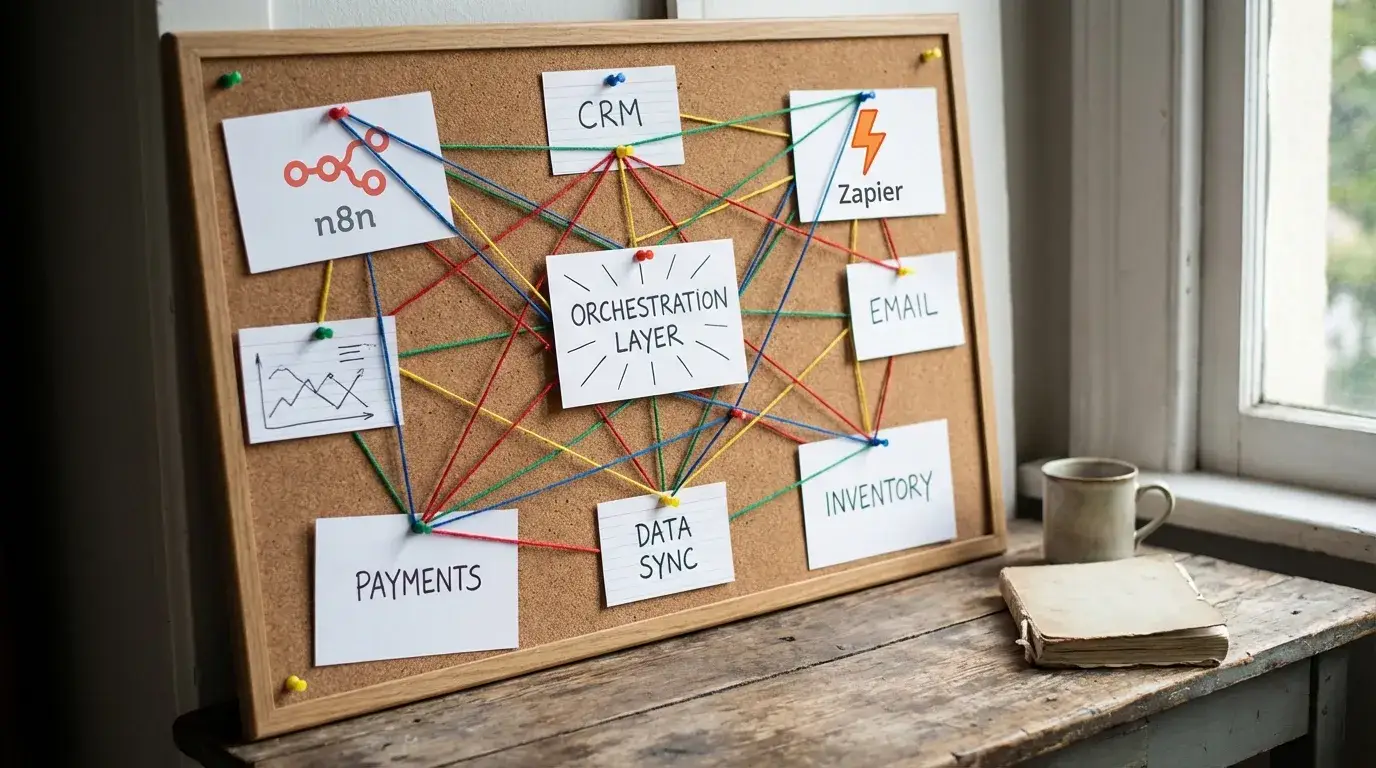
Implementing these workflows requires strict technical governance. A haphazard approach to automation—often characterized by hundreds of disjointed Zapier “Zaps”—creates a fragile infrastructure that breaks silently.
The Engineering Standard
Professional AI automation consulting demands:
1. Self-Healing Architecture: Workflows must include error-trigger nodes. If an API endpoint fails, the system must automatically retry the payload or gracefully alert the operations team before data is lost.
2. Security and API Governance: Enterprise automation requires localized credential management, secure OAuth2 protocols, and strict adherence to data privacy regulations (SOC2, GDPR).
3. Scalable Node-Based Infrastructure: Utilizing open-source or self-hosted platforms like n8n allows for limitless customization via JavaScript and ensures the organization retains total ownership of its data pipeline, free from restrictive vendor lock-in.
Conclusion: Engineering Predictable Scale
CRM and AI workflow automation are no longer optional “nice-to-haves” for enterprise organizations; they are the foundational requirements for survival and scale in 2026. By partnering with specialized consultants to architect intelligent, secure, and self-healing data pipelines, businesses can fundamentally decouple their revenue growth from their administrative headcount.