⚡ Key Takeaways
- A perfect 10/10 Quality Score isn’t always the most profitable goal. Focus on strategic optimization for your specific business objectives.
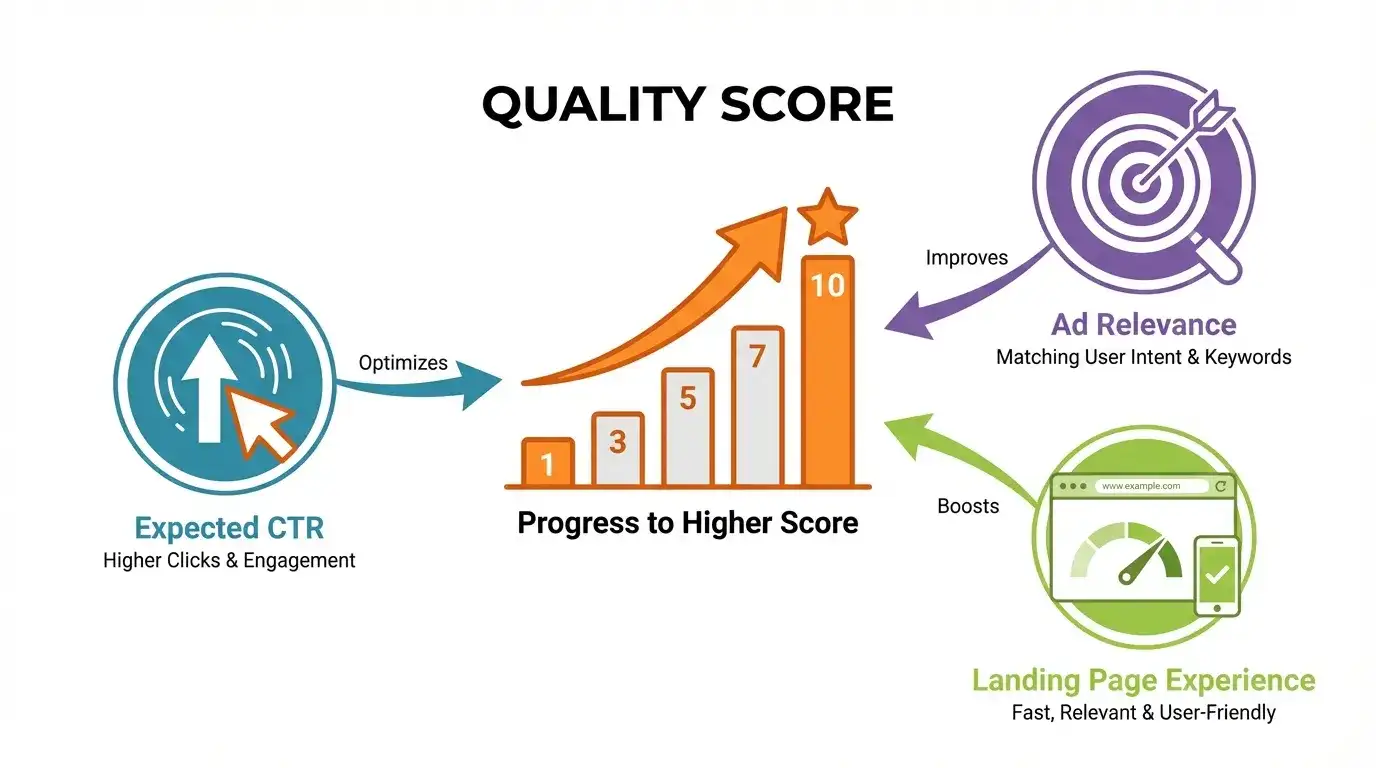
- Google Ads Quality Score comprises three key pillars: Expected Click-Through Rate (CTR), Ad Relevance, and Landing Page Experience.
- Even small improvements in Quality Score can significantly impact CPC and ad rank, directly affecting your return on ad spend (ROAS).
The Google Ads Quality Score Myth: When a 10/10 Isn’t Your Best Goal
It’s easy to get caught up in the idea that you absolutely must strive for the highest possible Quality Score. However, real-world campaign data from Goodish Agency shows that dedicating excessive resources to push a 7 or 8 to a 10 can yield diminishing returns. The core problem lies in misinterpreting Quality Score as a standalone achievement instead of a tool for cost-efficiency. Users frequently report frustration, asking: “My Quality Score is low even though my CTR is high – what gives?” or “I’ve done everything right, but my Quality Score won’t budge. Is it even worth chasing?” Sound familiar? This highlights a fundamental misunderstanding: Quality Score is a means to an end, not the end itself. For some niche keywords or specific campaign goals, a Quality Score of 5 or 6 might be perfectly acceptable, even strategic, if the conversions are profitable. Over-optimization beyond a certain point often diverts resources from other high-impact activities like conversion rate optimization or audience segmentation.
1. Analyze & Diagnose
Identify low QS keywords, ad groups, and components.
➔
2. Refine Keywords
Improve match types, implement robust negative keyword lists.
➔
3. Optimize Ad Copy
Craft compelling ads for higher Expected CTR and Ad Relevance.
➔
4. Enhance Landing Pages
Ensure speed, relevance, and clear calls-to-action.
➔
5. Monitor & Iterate
Continuously test, learn, and adjust for sustained performance.
Deconstructing Quality Score: The 3 Pillars of Performance
To strategically improve your Google Ads Quality Score, you’ve got to understand its foundational components. Google calculates your Quality Score based on three key factors. First, Expected CTR measures how likely users are to click your ad when presented with your keyword, based on historical performance. Second, Ad Relevance assesses how closely your ad copy matches the user’s search intent and your chosen keywords. If your ad promotes hiking boots but the keyword is “running shoes,” your relevance will definitely suffer. Finally, Landing Page Experience evaluates how relevant, transparent, and easy-to-navigate your landing page is for users who click your ad. A fast-loading, mobile-friendly page with clear calls to action and content matching the ad’s promise will score highly. Addressing each of these pillars directly is much more effective than broad, unfocused optimization efforts.
Turn Ad Spend Into Predictable Revenue
Quit relying on “boosting posts” and hope. We engineer full-funnel acquisition systems that nurture prospects from first click to loyal customer.
[
See Our Advertising Services
](/paid-advertising/)
[
Book a Free Audit Call
](https://calendly.com/bacar-franci/30min)
Quality Score vs. CPC & Ad Rank: A Real-World Perspective
Understanding the tangible impact of Quality Score on your campaign budget and visibility is crucial. This matrix illustrates how improvements can translate into significant cost savings and improved ad positioning, based on simulated industry averages.
| Quality Score Range | Typical CPC Impact | Potential Ad Rank Impact | Strategic Implication |
|---|---|---|---|
| 1-3 (Poor) | Up to +400% Higher CPC | Significant Rank Penalty | Immediate action required; high budget drain. |
| 4-6 (Average) | +50% to +150% Higher CPC | Moderate Rank Penalty | Significant improvement potential for cost savings. |
| 7-8 (Good) | -10% to -50% Lower CPC | Strong Rank Advantage | Solid baseline; focus on other KPIs unless issues arise. |
| 9-10 (Excellent) | -50% to -80% Lower CPC | Maximized Rank Advantage | Often marginal gains from 8 to 10; prioritize profitability. |
Beyond the Obvious: Pinpointing Hidden Quality Score Levers
Many advertisers only scratch the surface of Quality Score optimization. The real secret to improving your Google Ads Quality Score lies in granular account structure and sophisticated negative keyword strategies. Instead of just adding broad negative keywords, Goodish Agency implements dynamic negative keyword lists that update based on search queries, preventing irrelevant impressions before they ever hit your budget. Furthermore, moving beyond generic ad groups to highly focused, thematic ad groups (often known as Single Keyword Ad Groups or SKAGs, though advanced versions like Single Intent Ad Groups are more scalable) allows for hyper-relevant ad copy and landing page experiences for each specific user intent. This level of precision directly impacts Expected CTR and Ad Relevance components that can appear stubborn but respond dramatically to tightly controlled environments. For instance, if a keyword has a low Quality Score due to poor Ad Relevance, a quick audit often reveals the ad group contains too many disparate keywords, diluting its focus. Segmenting these into their own tightly themed groups with dedicated ad copy frequently solves the problem.
Strategic Optimization, Not Obsession: Your Quality Score Advantage
Improving Google Ads Quality Score isn’t about chasing a perfect number, but about strategically enhancing campaign efficiency and profitability. By focusing on Expected CTR, Ad Relevance, and Landing Page Experience, you directly impact your costs and ad prominence. Remember, the goal isn’t merely a higher score, but a more effective and profitable campaign. Always connect your optimization efforts back to key performance indicators like Cost Per Acquisition (CPA) and Return On Ad Spend (ROAS). If you’re struggling to diagnose and implement these advanced strategies, seeking expert guidance can transform your ad performance. Goodish Agency helps businesses leverage data and strategic insights to achieve genuine growth.
Expected CTR Focus
Drives more clicks, boosts ad visibility, and lowers CPC.
Ad Relevance Focus
Ensures ads match intent, reducing wasted spend and improving engagement.
Landing Page Experience
Increases conversion rates, reduces bounce, and validates ad promise.
Account Structure
Provides granular control, maximizing efficiency across all components.