B2B SaaS growth in 2026 is about efficiency, not growth at any cost. The companies that grow steadily do five things well: they pick a go-to-market motion that fits their contract size, position the product for a clearly defined buyer, get new users to value fast, price on the metric customers see as success, and measure CAC payback and net revenue retention rather than top-line sign-ups.
This guide covers each of those, plus where paid acquisition, analytics and automation fit. We write it from our work with US SaaS and fintech companies, where most of our engagements start with the same question: which of our numbers can we actually trust?
What is a B2B SaaS growth strategy?
It is the plan for how customers find, buy, adopt and expand their use of your product, and how you’ll know each step is working. It covers the whole lifecycle (awareness, consideration, purchase, activation, retention, expansion and referral), not just acquisition.
Two distinctions keep it honest:
- Growth marketing vs growth hacking. Growth hacking looks for one cheap trick that brings a burst of users. Growth marketing is the long-term system: testing channels, messages and offers across the funnel, and keeping what works. Tricks fade; systems compound.
- Strategy vs tactics. “Do more video” or “post on LinkedIn” are tactics. A strategy says who you are for, why they should choose you, and which motion gets you in front of them. On a small budget, a plain strategy executed well beats a brilliant one that leaves nothing for execution.
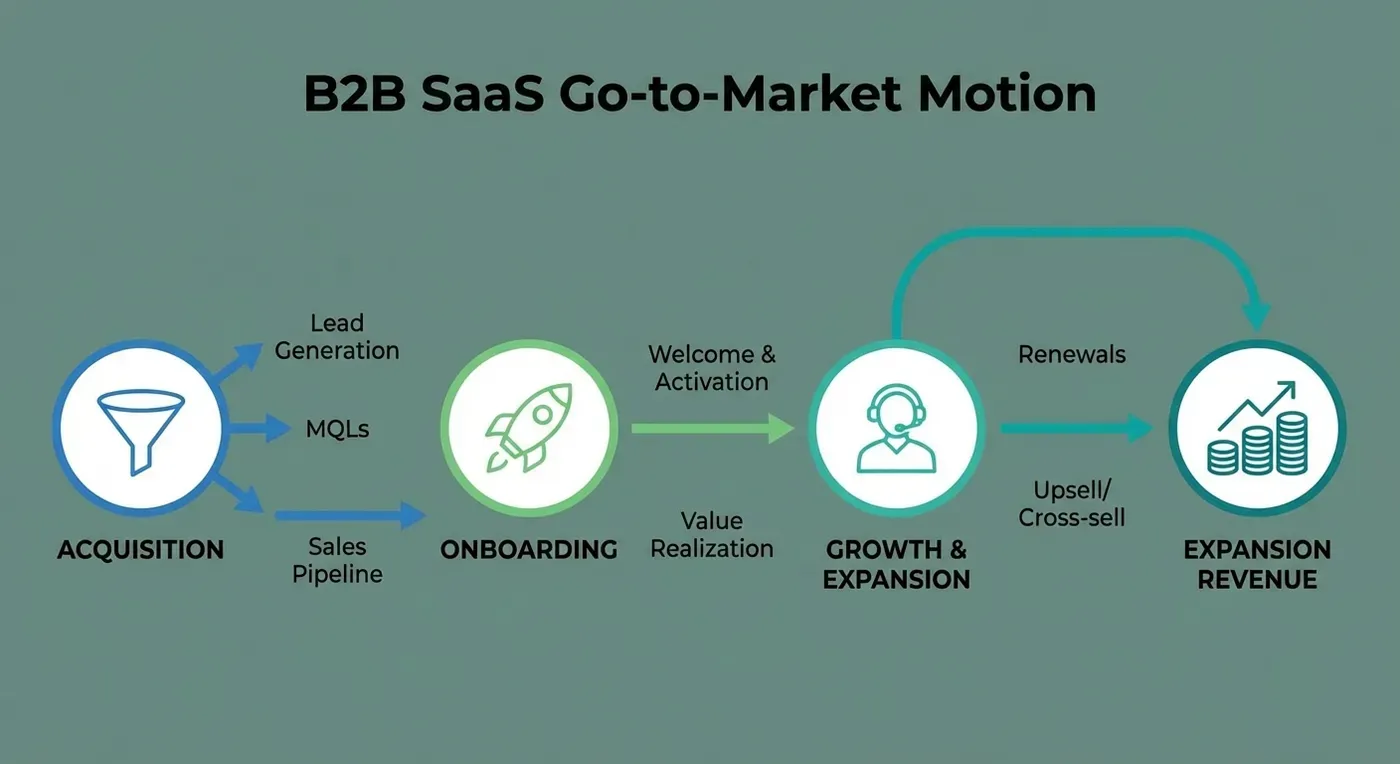
Which go-to-market motion fits: product-led, sales-led or hybrid?
Your contract size mostly decides it. The figures below are rough rules of thumb, not hard lines.
| Product-led growth (PLG) | Sales-led growth (SLG) | |
|---|---|---|
| How customers arrive | Free tier or self-serve trial | Outbound, account-based marketing, demos |
| Customer acquisition cost | Low per customer, high volume | High: a human sales cycle |
| Sales cycle | Minutes to days | Often 3 to 9+ months |
| Typical annual contract value | Often under $5,000 | Often above $25,000 |
| What you track | Product-qualified leads (PQLs) | Marketing- and sales-qualified leads, pipeline |
Product-led growth makes the product the main acquisition channel. It needs self-serve onboarding, a free tier or trial that delivers real value, and a clear point at which a user becomes worth a sales conversation.
Sales-led growth suits complex, high-value software, where procurement, security reviews and integrations need people: SDRs, account executives and often solutions engineers.
Hybrid (product-led sales) is increasingly common: let individuals or small teams start self-serve, then bring in sales when usage shows a company-wide opportunity.
How do you position a B2B SaaS product?
Positioning is the place your product holds in the buyer’s mind for a specific problem. Write it down as one sentence:
[Product] is the best option in [category] for [audience] who need [outcome], because [reason].
If any part is vague or too broad, the statement is useless. Three questions help:
- What are customers actually buying? Not the feature list, but the outcome: time saved, risk avoided, a report the board stops questioning.
- Who exactly? The group with the greatest need that is also most likely to buy, that you can reach, and that you can serve well. Early on, that is usually enthusiasts and specialists, not the whole market.
- Why you? If the product isn’t clearly different, own a reason buyers care about: the best support, the deepest integration with their stack, the strongest fit for their industry.
Positioning is ultimately what customers say about you, not what you say. Every ad, onboarding email and support reply either confirms it or erodes it. For awareness campaigns, the test is simple: does each ad grab attention, convey meaning and stay memorable? Missing any one of the three wastes the spend.
Which SaaS metrics matter most?
| Metric | What it tells you | Common benchmark |
|---|---|---|
| CAC (customer acquisition cost) | Fully loaded sales and marketing cost per new customer | Depends on contract value |
| LTV (lifetime value) | Gross margin from a customer over the relationship | LTV:CAC above 3:1 |
| CAC payback | Months to recover CAC from gross margin | Under 12 months |
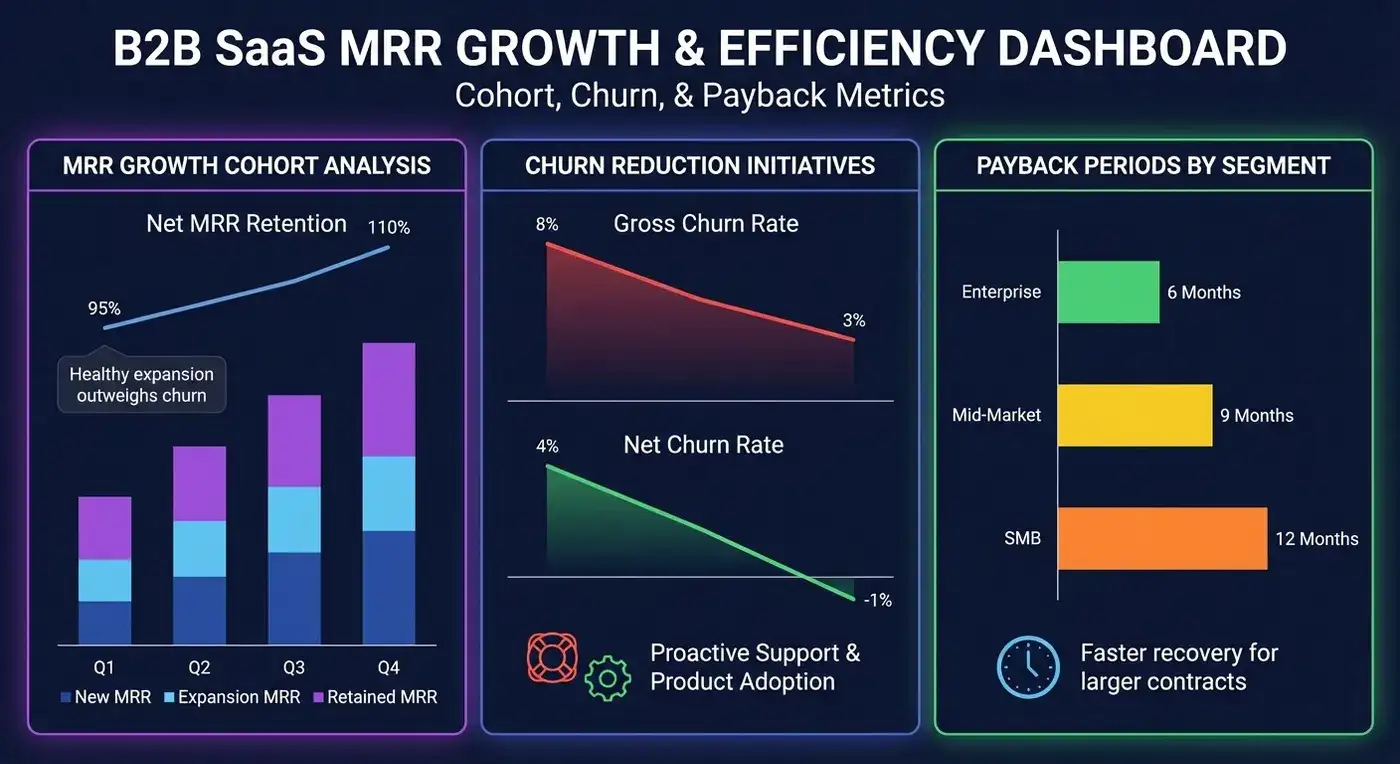
| NRR (net revenue retention) | Revenue kept from existing customers, including expansion and churn | Above 100%; strong is 110%+ |
| SaaS Quick Ratio | (New + expansion MRR) ÷ (churned + contraction MRR) | Above 4 is excellent |
| Rule of 40 | Growth rate + profit margin | 40% or more |
These are widely used rules of thumb, not laws. What matters more is that the inputs are right. In our audits, the most common problem isn’t a bad ratio but a CAC that nobody can calculate, because ad platforms, analytics and the CRM count conversions differently.
The fix is a measurement setup where marketing analytics (GA4), product analytics (Mixpanel or PostHog) and the CRM share one user ID, and revenue comes from the CRM or billing system. We cover which events to track in GA4 for SaaS companies and compare product analytics tools in GA4 vs Mixpanel.
How do you map the B2B SaaS buyer journey?
B2B buyers move through stages, and each needs different content, channels and measurement:
| Stage | What the buyer does | What you do and measure |
|---|---|---|
| Unaware | Lives with the problem | Little you can do directly |
| Problem aware | Starts noticing the cost of the problem | Educational content, social, search; track engaged visits |
| Solution aware | Researches approaches | Comparison content, retargeting; track return visits |
| Product aware | Shortlists vendors, checks pricing | Pricing page, case studies, demos; track key events |
| Trial | Tests the product, talks to sales | Onboarding emails, in-app guidance; track activation |
| Decision | Compares and buys | Sales follow-up, proposals; track closed-won in the CRM |
| Advocate | Recommends you | Referral programs, community; track referrals |
The tooling behind it doesn’t need to be elaborate. For most SMEs the marketing stack isn’t mission-critical: pick tools your team actually masters, keep one source of truth for revenue, and choose a north-star metric before you add dashboards.
How do you shorten time-to-value?
The faster a new user reaches the moment the product proves its worth, the lower early churn. In practice:
- Define the product-qualified lead. Use your own data to find the usage pattern (a number of teammates invited, projects created, reports exported) that predicts conversion. Then point onboarding at it.
- Defer account creation where you can. Let people see a result before asking for an email.
- Profile progressively. Ask for company size and role later, inside the product, not on the first screen.
- Design empty states. A first-time dashboard should offer one clear next action, or sample data to explore.
- Borrow from premium buying experiences. For higher tiers, a well-run onboarding call or a personal setup can feel like a luxury purchase at very little cost.
For TMT Finance, a UK financial media and funding business, the bottleneck wasn’t traffic but the onboarding flow. Product analytics and UX forensics showed where applicants dropped off; once the flow was fixed and Google Ads relaunched on the new conversion data, cost per lead fell from $2,140 to $48.74 (read the case).
How should you price and package a SaaS product?
- Price on a value metric. Seats, transactions, API calls or data processed: whichever grows as the customer gets more value.
- Offer three or four clear tiers. Highlight the one most customers should choose. A higher enterprise tier makes the middle one look reasonable (the decoy effect).
- Mix feature gating and usage gating. Usage limits capture natural growth; advanced features such as SSO, custom reporting and API access capture organisational complexity.
- Encourage annual billing. A discount or extra onboarding for annual plans improves cash flow and gives you a year to prove value.
- Revisit pricing. Many companies set it once and never test it again.
How do you reduce churn and grow expansion revenue?
- Run customer success, not just support. Map the first 90 days after purchase: deployment, adoption, a first measurable win, then a review with the buyer.
- Build a health score from product usage trends, feature adoption, support tickets and failed payments. When it drops, trigger a playbook before the renewal conversation.
- Automate expansion triggers. When an account nears its plan limit, alert the account owner or start a self-serve upgrade sequence.
- Mind the context, not only the product. Retention often depends on the experience around the product: support, billing, communication and how well it meets the expectations your marketing set.
- Align sales compensation with retention. Clawbacks on early churn and credit for expansion stop reps closing bad-fit customers.
Much of this runs on automation between the product, the CRM and billing. Our n8n and workflow automation masterclass covers the architecture.
What changes when you move upmarket?
Enterprise deals add procurement, legal and IT security to the buying group. Expect security questionnaires and compliance requirements (SOC 2 reports, GDPR terms, and sector-specific rules such as HIPAA in healthcare), single sign-on, uptime commitments in an SLA, and technical evaluations led by a solutions engineer. Plan for these before you chase enterprise logos; missing one can stall a deal for months.
Where does paid acquisition fit in SaaS growth?
Once positioning and onboarding work, paid channels scale what already converts. The rule we follow: let the ad platforms learn from qualified pipeline, not from form fills. For iSoftpull, a US B2B credit-data software company, connecting Meta and Google Ads to product-usage data and cutting spend on low-intent audiences took the cost per qualified lead from $205.41 to $25.84 between late 2024 and early 2026 (read the case).
Our paid acquisition playbook explains the setup, and our paid advertising service runs it for SaaS and fintech companies.
FAQ
What is the best growth strategy for a B2B SaaS startup?
Start narrow: one clearly defined buyer, positioning written down, and an onboarding flow that gets new users to value fast. Add paid acquisition once you can measure which channels bring customers who stay.
Should a B2B SaaS company be product-led or sales-led?
Let contract size and complexity decide. Lower-priced, self-serve products suit product-led growth; complex, high-value software needs sales. Many companies combine both.
What is a good net revenue retention for B2B SaaS?
Above 100% means existing customers grow revenue even before new sales. Around 110% or more is commonly seen as strong, but compare yourself with companies of a similar size and segment.
How do you measure SaaS marketing performance?
Connect GA4, product analytics and the CRM with one user ID, take revenue from the CRM or billing system, and judge channels on CAC payback and retention rather than sign-ups.
If you want a second look at your funnel, measurement or paid channels, talk to us.