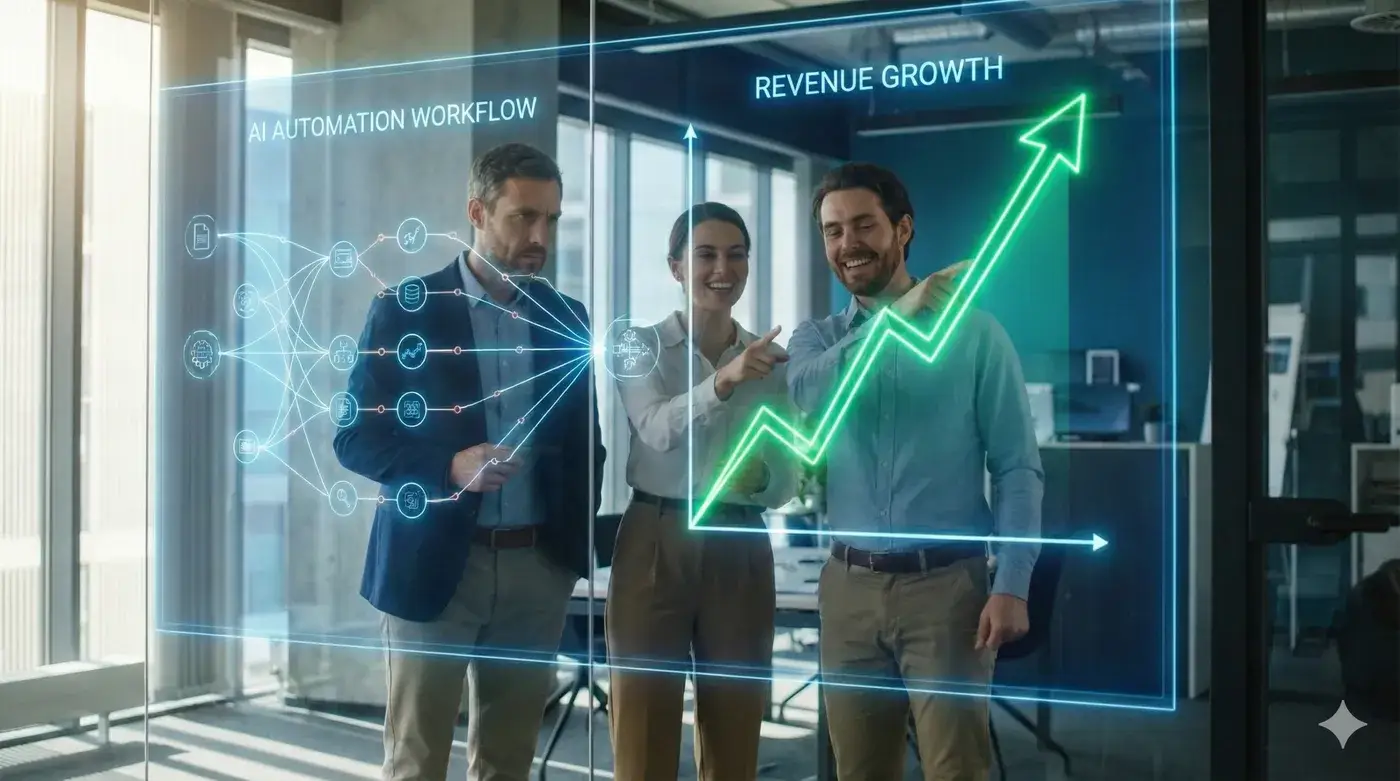
An AI automation agency finds the repetitive work in your business (lead research, data entry, reporting, first drafts, routing) and builds workflows that do it, using AI models where a task needs judgement on text. A good one also decides what a person must still approve, connects the workflows to the tools you already use, and keeps them running after launch.
That is the short answer. Below is what the work looks like in practice, what it costs, how it differs from an IT firm or a marketing agency, and how to choose a partner. We write from our own experience: Goodish builds these workflows for clients, mostly in n8n, and runs its own agency on them.
What is an AI automation agency?
It is a team that combines three jobs: process consultant, integration developer and AI engineer. It maps how work moves through your company, picks the steps where automation pays back, and builds them.
The “AI” part matters less than people expect. Plenty of valuable automation is plain rules: when a form is submitted, create the CRM record, notify the owner, send the confirmation. AI models come in where the input is unstructured, such as reading an email, summarising a call, classifying a lead or drafting a reply. Most useful workflows mix both.
What does an AI automation agency actually build?
These are the workflows we build most often, and the ones we’d start with in most marketing and sales teams:
| Workflow | What it does | Typical tools |
|---|---|---|
| Lead qualification | Scores and enriches incoming leads before they reach sales | Typeform, OpenAI, Zoho or HubSpot |
| Sales research | Gathers company news and context before every call | Calendly, an LLM, the CRM |
| Automated reporting | Pulls ads, analytics and CRM data into a weekly report | GA4, Google Sheets, Slack |
| Knowledge-base assistant | Answers questions from your own documents | Website chat or WhatsApp, Gemini, Drive |
| Content repurposing | Turns one transcript into posts and a blog draft, queued for review | YouTube, Claude, WordPress |
| Performance alerts | Flags anomalies across ad platforms and analytics | Ads APIs, GA4, Slack |
CRM work is often the biggest win, because the CRM is where manual copying piles up. For iSoftpull, a US credit-data software company, we run the CRM end to end, including the API integrations that keep it in sync with the product. Our CRM and workflow automation service covers that side.
We also build for ourselves. eKmet, our voice-first app for Slovenian farmers, and SocialAI, our social-media software for agencies, are both in production.
How is it different from an IT firm or a marketing agency?
- An IT firm keeps infrastructure running: devices, networks, security, licences. Process redesign is rarely its job.
- A marketing agency brings in customers through campaigns and content. It may use AI tools, but it doesn’t usually rebuild how your team works.
- An AI automation agency works on the processes in between: how a lead becomes a deal, how data gets from one system to another, how a report gets made. Its output is working software, not advice or ads.
There is also a difference between consulting and execution. A pure consultant maps opportunities and writes a roadmap; an execution agency builds and maintains the workflows. Small and mid-sized companies are usually better served by one team that does both, so the people who recommend a workflow are the ones who have to make it work.
How does a project with an AI automation agency work?
- Audit. Map the manual work: who does what, how often, in which tools. Check whether the data the automation needs exists and is clean enough.
- Prioritise. Pick the two or three processes where automation pays back fastest, and agree what a person must still approve.
- Build and test. Build the workflows, connect them to your tools, and test them on real data, not demo data.
- Launch and hand over. Go live with monitoring, and document what runs, when, and how to stop it.
- Maintain. APIs change, models change, and your processes change. Someone has to own the workflows after launch.
Why should a human approve what the AI does?
Because AI models are confident even when they are wrong. A made-up detail in a customer email or a wrong field in the CRM costs more than the time the automation saved.
So in what we build, the agent writes to a review queue, and nothing reaches a customer or a record until a person approves it. You can relax that later for low-risk steps, deliberately. We explain the pattern in human-in-the-loop AI automation, and how agents differ from fixed workflows in the agentic workflow.
How much does an AI automation agency cost?
Pricing models vary: fixed price per project, a monthly retainer for ongoing work, or a mix. The cost depends mostly on how many systems a workflow touches and how much judgement it needs.
At Goodish, we quote on scope after a free audit. Running costs come on top: the automation platform (n8n can be self-hosted), and AI model usage, which is billed per use by the model provider.
Should you hire an agency, buy a tool or build in-house?
- Off-the-shelf AI tools are quick and cheap for one job, but you adapt your process to the tool, and data ends up scattered across subscriptions.
- In-house makes sense once automation is core to your product and you can keep at least one engineer on it. Most small and mid-sized companies can’t yet.
- An agency fits in between: custom workflows on your own tools, without hiring a team. Insist on documentation and access to everything built, so you can take it in-house later.
How do you choose the right AI automation agency?
- Ask for workflows in production, not demos. What runs today, for whom, and what broke last month?
- Ask what a person approves. If the answer is “nothing, it’s fully autonomous”, be careful.
- Check the tool stance. A good agency explains why it picks a platform and a model for your case, and doesn’t lock you into one vendor.
- Ask who owns the result. You should own the accounts, the workflows and the data.
- Start with a pilot. One process, measured before and after, tells you more than any proposal.
For a longer comparison of agencies, see our list of AI automation agencies and how to choose one.
What doesn’t an AI automation agency do?
It doesn’t fix a broken process by automating it; a messy process automated is just faster mess, so the process gets cleaned up first. It doesn’t replace your team: in our experience the hours saved go to work people were putting off, not to cutting staff. And it shouldn’t promise results before it has seen your data.
FAQ
What is an AI automation agency?
A team that maps the repetitive work in your company and builds automated workflows to do it, using AI models where a task involves reading, classifying or writing text. It connects those workflows to your existing tools and maintains them.
What can an AI automation agency do for a small business?
Usually it starts with lead handling, CRM data entry, reporting and answering common customer questions. Those are frequent, manual and easy to measure, so the payback is visible within weeks.
Is AI automation safe for customer-facing work?
It is when a person approves anything that reaches a customer or changes a record. We build every agent to write to a review queue first.
Which tools do AI automation agencies use?
Workflow platforms such as n8n, Make or Zapier to connect the systems, and AI models from OpenAI, Anthropic (Claude) or Google (Gemini) for the text-heavy steps. We mostly use n8n because it can be self-hosted.
To see where automation would pay back first in your team, read about our AI automation service or book the free audit.